Ground-referenced color
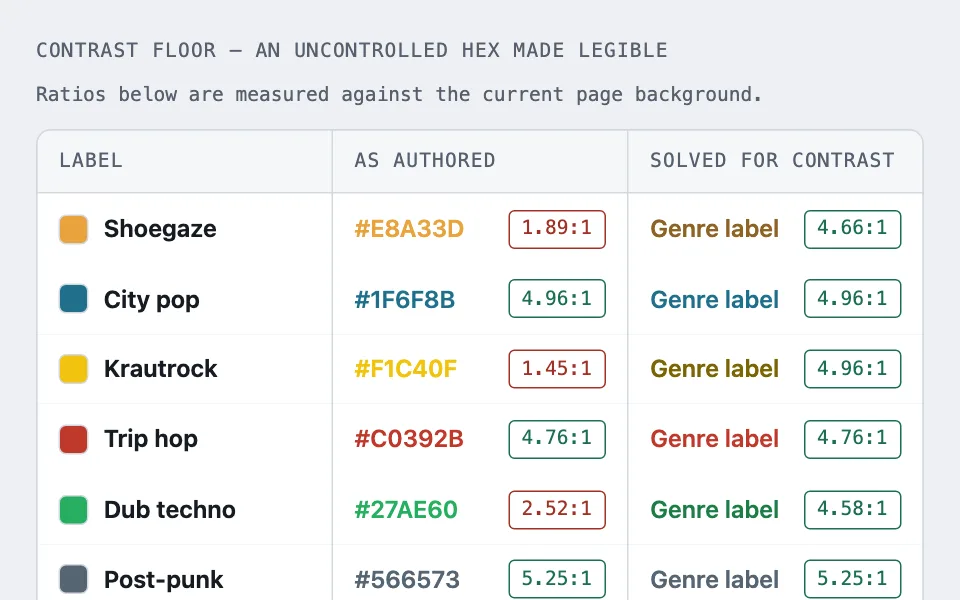
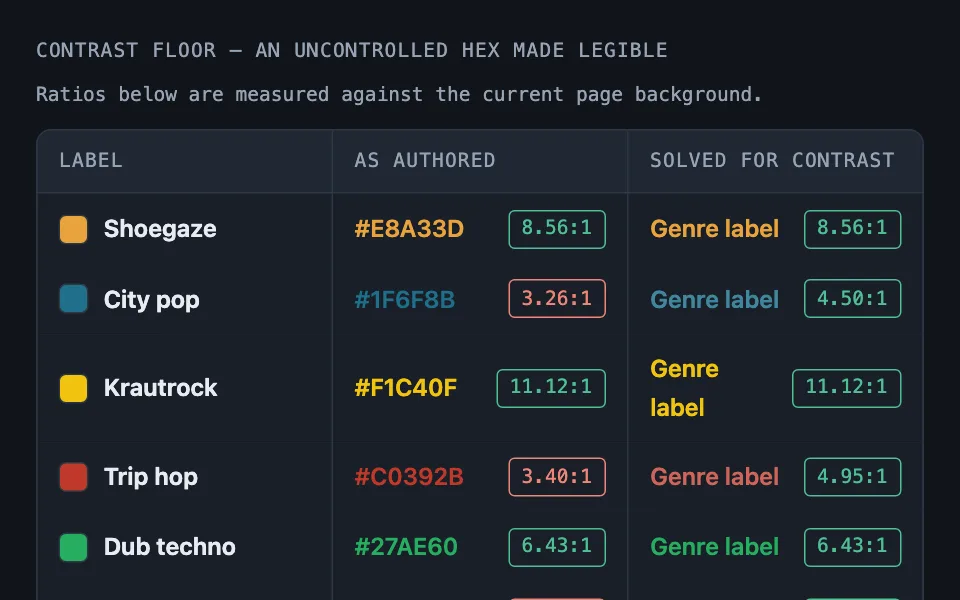
Two jobs solved against the page’s own ground token rather than a synthetic white or black — walking an uncontrolled brand hex until it clears a 4.5:1 floor, and mixing an ordered intensity ramp across a full year of linked days — so both invert correctly between themes from one expression.
Reach for it when building
- user-picked tag colors
- third-party brand colors
- channel or label colors on a dashboard
- calendar event colors
- contribution calendar
- a year of daily activity with month labels
- usage heatmap
- streak and habit trackers
- density grids
<div class="grc-demo">
<section class="grc-block">
<p class="grc-label">Contrast floor — an uncontrolled hex made legible</p>
<p class="grc-caption">Ratios below are measured against the current page background.</p>
<div class="grc-table" role="table" aria-label="Brand colors before and after contrast solving">
<div class="grc-row grc-head" role="row">
<span role="columnheader">Label</span>
<span role="columnheader">As authored</span>
<span role="columnheader">Solved for contrast</span>
</div>
<div id="grc-rows"></div>
</div>
</section>
<section class="grc-block">
<p class="grc-label">Intensity ramp — washed over whatever surface it sits on</p>
<p class="grc-caption">A full year, so the ramp is read against the months it runs through rather than in isolation.</p>
<div class="grc-panel">
<p class="grc-panel-hint">This grid sits on a surface panel, not the page ground, on purpose — the ramp still has to read correctly here.</p>
<div class="grc-scroll">
<div class="grc-year">
<div class="grc-months" id="grc-months" aria-hidden="true"></div>
<div class="grc-grid" id="grc-grid" aria-label="Sample daily activity for the last 52 weeks"></div>
</div>
</div>
<p class="grc-readout" id="grc-readout" role="status">Every day with activity is a link to that day.</p>
<div class="grc-legend">
<span>Less</span>
<span class="grc-cell grc-level-0"></span>
<span class="grc-cell grc-level-1"></span>
<span class="grc-cell grc-level-2"></span>
<span class="grc-cell grc-level-3"></span>
<span class="grc-cell grc-level-4"></span>
<span>More</span>
</div>
</div>
</section>
</div>Colors come from shared theme tokens — --surface, --ink, --border, --accent and friends — so this CSS carries no palette
of its own. Use Runnable file to copy the tokens along with it.
.grc-demo { display: flex; flex-direction: column; gap: 1.75rem; }

.grc-block { display: flex; flex-direction: column; gap: 0.5rem; }

.grc-label {
	margin: 0;
	font-family: var(--mono);
	font-size: 0.8125rem;
	letter-spacing: 0.06em;
	text-transform: uppercase;
	color: var(--dim);
}

.grc-caption {
	margin: 0 0 0.25rem;
	font-family: var(--mono);
	font-size: 0.8125rem;
	color: var(--dim);
}

/* ---------------------------------------------------------------
   Variation one — solve an uncontrolled color against the ground.
   --------------------------------------------------------------- */

.grc-table {
	display: grid;
	gap: 1px;
	background: var(--border);
	border: 1px solid var(--border);
	border-radius: var(--radius);
	overflow: hidden;
}

.grc-row {
	display: grid;
	grid-template-columns: minmax(120px, 1fr) 1fr 1fr;
	gap: 1px;
	background: var(--border);
}

.grc-row > span {
	background: var(--surface);
	padding: 0.65rem 0.9rem;
	display: flex;
	align-items: center;
	gap: 0.6rem;
	min-width: 0;
}

.grc-head > span {
	background: var(--surface-2);
	font-family: var(--mono);
	font-size: 0.8125rem;
	text-transform: uppercase;
	letter-spacing: 0.06em;
	color: var(--dim);
}

.grc-dot {
	width: 20px;
	height: 20px;
	border-radius: 5px;
	flex: 0 0 auto;
	border: 1px solid var(--border);
}

.grc-name {
	font-weight: 650;
	min-width: 0;
	overflow: hidden;
	text-overflow: ellipsis;
	white-space: nowrap;
}

.grc-value {
	display: flex;
	align-items: center;
	justify-content: space-between;
	gap: 0.6rem;
	width: 100%;
}

.grc-sample { font-weight: 600; }

.grc-verdict {
	font-family: var(--mono);
	font-size: 0.8125rem;
	padding: 0.1rem 0.5rem;
	border-radius: 4px;
	white-space: nowrap;
}

.grc-pass { color: var(--ok); border: 1px solid var(--ok); }
.grc-fail { color: var(--bad); border: 1px solid var(--bad); }

/* ---------------------------------------------------------------
   Variation two — wash an ordered scale over transparent, so it
   composites correctly on whatever surface it is actually painted
   over rather than being solved for the page ground specifically.
   --------------------------------------------------------------- */

.grc-panel {
	background: var(--surface);
	border: 1px solid var(--border);
	border-radius: var(--radius);
	padding: 1rem;
	display: flex;
	flex-direction: column;
	gap: 0.5rem;
}

.grc-panel-hint {
	margin: 0;
	font-size: 0.9375rem;
	color: var(--dim);
	font-style: italic;
}

.grc-grid {
	display: grid;
	grid-auto-flow: column;
	grid-template-rows: repeat(7, 15px);
	/* Implicit column tracks size to auto and would stretch to fill the
	   container, spreading the weeks apart. Pin them to the cell width and
	   pack the whole grid to the start instead. */
	grid-auto-columns: 15px;
	justify-content: start;
	gap: 3px;
}

/* The year is wider than most containers, so it scrolls on its own rather
   than squeezing the cells below a hittable size. */
.grc-scroll { overflow-x: auto; padding-bottom: 0.25rem; }
.grc-year { display: inline-flex; flex-direction: column; gap: 0.3rem; }

/* Month labels are fixed-width blocks in the flow, each as wide as the weeks
   it covers. Absolute positioning fights the scroll container and drifts. */
.grc-months { display: flex; font-size: 0.9375rem; color: var(--dim); }
.grc-month { flex: 0 0 auto; }

.grc-cell {
	width: 15px;
	height: 15px;
	border-radius: 3px;
	/* Without this, the palest live steps have no edge against a light ground
	   and read as empty days. */
	box-shadow: inset 0 0 0 1px color-mix(in srgb, var(--dim) 22%, transparent);
}

/* A day with activity is a link to that day's entries: the ramp shows the
   shape, the link does the work. */
button.grc-cell { border: none; padding: 0; cursor: pointer; font: inherit; }
button.grc-cell:hover { box-shadow: inset 0 0 0 1px var(--ink); }

.grc-readout { margin: 0.5rem 0 0; font-size: 0.9375rem; color: var(--dim); min-height: 1.6em; }

/* Every level is a wash over transparent, not a mix into a specific ground
   colour, so the ramp composites correctly over whatever is actually
   painted underneath it -- the page background in the plain case, or a
   --surface / --surface-2 panel wherever the grid sits on one, as it does
   in this demo. Mixing into --ground directly, the earlier approach, is
   only correct when the grid happens to sit straight on the page; one
   panel up, the same math is solved against the wrong background and can
   land level 0 within a hair of the panel behind it. Level 0 mixes a
   neutral, never the palest step of the accent hue, so "nothing happened"
   cannot be mistaken for "a little happened". Levels 1-4 mix the accent at
   increasing strength; level 4 is the accent at full strength with no mix
   at all. */
.grc-level-0 { background: color-mix(in srgb, var(--dim) 22%, transparent); }
.grc-level-1 { background: color-mix(in srgb, var(--accent) 34%, transparent); }
.grc-level-2 { background: color-mix(in srgb, var(--accent) 56%, transparent); }
.grc-level-3 { background: color-mix(in srgb, var(--accent) 78%, transparent); }
.grc-level-4 { background: var(--accent); }

.grc-legend {
	display: flex;
	align-items: center;
	gap: 0.5rem;
	margin-top: 0.5rem;
	font-size: 0.9375rem;
	color: var(--dim);
}
// The page ground is the reference both halves are solved against, so both
// read it the same way and fall back to the light token if it is missing.
function groundReference() {
var groundValue = getComputedStyle(document.documentElement).getPropertyValue('--ground').trim();
return /^#[0-9a-f]{6}$/i.test(groundValue) ? groundValue : '#eef0f3';
}
// --- Variation one: walk a hex until it clears the floor -----------------
(function () {
var rowsContainer = document.getElementById('grc-rows');
// Every hex here stands in for an uncontrolled color a user could enter;
// they are the demo's data, not a restatement of the theme palette.
var labelColors = [
{ name: 'Shoegaze', hex: '#E8A33D' },
{ name: 'City pop', hex: '#1F6F8B' },
{ name: 'Krautrock', hex: '#F1C40F' },
{ name: 'Trip hop', hex: '#C0392B' },
{ name: 'Dub techno', hex: '#27AE60' },
{ name: 'Post-punk', hex: '#566573' }
];
function hexToRgb(hex) {
var clean = hex.trim();
return [
parseInt(clean.slice(1, 3), 16),
parseInt(clean.slice(3, 5), 16),
parseInt(clean.slice(5, 7), 16)
];
}
function rgbToHex(rgb) {
return '#' + rgb.map(function (channel) {
var clamped = Math.round(Math.min(255, Math.max(0, channel)));
var hexPart = clamped.toString(16);
return hexPart.length === 1 ? '0' + hexPart : hexPart;
}).join('');
}
function relativeLuminance(rgb) {
var linear = rgb.map(function (channel) {
var value = channel / 255;
return value <= 0.04045 ? value / 12.92 : Math.pow((value + 0.055) / 1.055, 2.4);
});
return 0.2126 * linear[0] + 0.7152 * linear[1] + 0.0722 * linear[2];
}
function contrastRatio(foregroundHex, backgroundHex) {
var foregroundLuminance = relativeLuminance(hexToRgb(foregroundHex));
var backgroundLuminance = relativeLuminance(hexToRgb(backgroundHex));
var lighter = Math.max(foregroundLuminance, backgroundLuminance);
var darker = Math.min(foregroundLuminance, backgroundLuminance);
return (lighter + 0.05) / (darker + 0.05);
}
function mixToward(hex, targetHex, amount) {
var fromRgb = hexToRgb(hex);
var towardRgb = hexToRgb(targetHex);
return rgbToHex(fromRgb.map(function (channel, index) {
return channel + (towardRgb[index] - channel) * amount;
}));
}
// Walks a hex toward whichever pole the ground is farther from, in fixed
// steps, stopping the moment the ratio clears the floor so as much of the
// original hue as possible survives.
function readableOn(hex, backgroundHex, minimumRatio) {
var floor = minimumRatio || 4.5;
var mixTarget = relativeLuminance(hexToRgb(backgroundHex)) > 0.5 ? '#000000' : '#ffffff';
var current = hex;
for (var step = 0; step < 40; step += 1) {
if (contrastRatio(current, backgroundHex) >= floor) break;
current = mixToward(current, mixTarget, 0.08);
}
return current;
}
var reference = groundReference();
rowsContainer.innerHTML = labelColors.map(function (label) {
var solvedHex = readableOn(label.hex, reference);
var rawRatio = contrastRatio(label.hex, reference);
var solvedRatio = contrastRatio(solvedHex, reference);
var rawVerdict = rawRatio >= 4.5 ? 'grc-pass' : 'grc-fail';
var solvedVerdict = solvedRatio >= 4.5 ? 'grc-pass' : 'grc-fail';
return '<div class="grc-row" role="row">' +
'<span role="cell"><span class="grc-dot" style="background:' + label.hex + '"></span>' +
'<span class="grc-name">' + label.name + '</span></span>' +
'<span role="cell" class="grc-value"><span class="grc-sample" style="color:' + label.hex + '">' + label.hex + '</span>' +
'<span class="grc-verdict ' + rawVerdict + '">' + rawRatio.toFixed(2) + ':1</span></span>' +
'<span role="cell" class="grc-value"><span class="grc-sample" style="color:' + solvedHex + '">Genre label</span>' +
'<span class="grc-verdict ' + solvedVerdict + '">' + solvedRatio.toFixed(2) + ':1</span></span>' +
'</div>';
}).join('');
})();
// --- Variation two: an ordered scale mixed into the ground ---------------
(function () {
var WEEK_COUNT = 52;
var DAY_COUNT = 7;
var SEED = 20260810;
// mulberry32 — deterministic and dependency-free, so the sample grid is
// identical on every reload instead of reshuffling like Math.random would.
function createSeededRandom(seed) {
var state = seed >>> 0;
return function () {
state = (state + 0x6d2b79f5) >>> 0;
var mixed = state;
mixed = Math.imul(mixed ^ (mixed >>> 15), mixed | 1);
mixed ^= mixed + Math.imul(mixed ^ (mixed >>> 7), mixed | 61);
return ((mixed ^ (mixed >>> 14)) >>> 0) / 4294967296;
};
}
function levelForCount(count) {
if (count === 0) return 0;
if (count <= 2) return 1;
if (count <= 4) return 2;
if (count <= 6) return 3;
return 4;
}
var MONTH_NAMES = ['Jan', 'Feb', 'Mar', 'Apr', 'May', 'Jun', 'Jul', 'Aug', 'Sep', 'Oct', 'Nov', 'Dec'];
var CELL_STRIDE = 18; // cell width plus gap, so a label spans whole columns
var randomValue = createSeededRandom(SEED);
var grid = document.getElementById('grc-grid');
var monthsRow = document.getElementById('grc-months');
var readout = document.getElementById('grc-readout');
var fragment = document.createDocumentFragment();
// A fixed Monday start, so the columns are whole weeks and the demo does not
// redraw differently depending on the day it is opened.
var startDate = new Date(2025, 8, 15);
var monthStarts = [];
for (var week = 0; week < WEEK_COUNT; week += 1) {
for (var day = 0; day < DAY_COUNT; day += 1) {
var index = week * DAY_COUNT + day;
var cellDate = new Date(startDate.getTime());
cellDate.setDate(startDate.getDate() + index);
var isWeekend = day === 5 || day === 6;
var weight = isWeekend ? 0.35 : 1;
var count = randomValue() < 0.22 ? 0 : Math.max(0, Math.round(randomValue() * 9 * weight));
var level = levelForCount(count);
var entryWord = count === 1 ? 'minute' : 'minutes';
var dayLabel = cellDate.toDateString();
// An empty day is not interactive: there is nothing behind it to open,
// and a link to an empty page is worse than no link.
var cell = document.createElement(count === 0 ? 'span' : 'button');
cell.className = 'grc-cell grc-level-' + level;
cell.title = count + ' ' + entryWord + ' on ' + dayLabel;
if (count === 0) {
cell.setAttribute('aria-hidden', 'true');
} else {
cell.type = 'button';
cell.setAttribute('aria-label', count + ' ' + entryWord + ' on ' + dayLabel);
(function (localCount, localWord, localLabel) {
cell.addEventListener('click', function () {
readout.textContent = localCount + ' ' + localWord + ' on ' + localLabel + ' — opens that day filtered.';
});
})(count, entryWord, dayLabel);
}
fragment.appendChild(cell);
if (cellDate.getDate() === 1) {
monthStarts.push({ week: week, month: cellDate.getMonth() });
}
}
}
grid.appendChild(fragment);
// Each label is as wide as the weeks it covers, laid out in the flow, so the
// row scrolls with the grid instead of drifting away from it.
if (monthStarts.length > 0 && monthStarts[0].week > 0) {
var lead = document.createElement('span');
lead.className = 'grc-month';
lead.style.width = monthStarts[0].week * CELL_STRIDE + 'px';
monthsRow.appendChild(lead);
}
monthStarts.forEach(function (entry, position) {
var nextWeek = position + 1 < monthStarts.length ? monthStarts[position + 1].week : WEEK_COUNT;
var label = document.createElement('span');
label.className = 'grc-month';
label.style.width = (nextWeek - entry.week) * CELL_STRIDE + 'px';
label.textContent = MONTH_NAMES[entry.month];
monthsRow.appendChild(label);
});
})();Paste this into an agent to rebuild the pattern from scratch.
Two colour jobs share one rule: solve against the page's own ground token, never against a synthetic white or black. Every themed page background is a tint of something, and treating it as pure white or pure black systematically produces the wrong answer. Build whichever half you need — they are independent — but take the reference from the same place.
**Job one: make an uncontrolled colour legible.** Take an arbitrary hex a user or an external feed supplied — a tag colour someone picked, a channel's brand colour, a label from a syndicated source — and return a colour that clears a 4.5:1 contrast ratio against the page background in both themes, keeping as much of the original hue as it can. Skip this entirely for anything already inside the design system: a token chosen by a human and checked once needs no runtime solver, and running one against fixed palette colours just adds indirection.
The core is four pure functions with no framework dependency. Relative luminance follows the WCAG formula: normalise each channel to 0–1, apply the piecewise gamma curve (linear below 0.04045, a power curve above), weight the channels 0.2126 / 0.7152 / 0.0722 and sum. Contrast ratio takes the lighter and darker of two luminances and returns (lighter + 0.05) / (darker + 0.05). A mixing step walks one hex toward a target — pure black or pure white, whichever pole the *ground* is farther from — by a fixed fraction per call, most naturally 8%. The solver repeats that mix in a bounded loop, recomputing the ratio after each step and stopping the instant it clears the floor, so an already-legible colour is returned untouched and a hard case is pushed only as far as it needs to go.
Note where the ground appears in that: it is the thing contrast is *measured against*, and the thing that decides which pole to walk toward. Solving light mode against pure white will systematically undershoot, because the real ground is darker than white.
At runtime this collapses to one CSS value. Precompute the light-solved and dark-solved hex once, offline, and ship color: light-dark(lightSolved, darkSolved) — one property, no media query, no JavaScript in the paint path. The loop only ever runs once per input colour, not per render.
light-dark() has a sharp edge worth a comment next to the code: it resolves against the page's used color-scheme, not the OS setting directly. If a stylesheet declares color-scheme: light dark after a framework has already set the page's scheme, that declaration wins, the page is pinned to "supports both", and the browser hands the choice back to the OS — so a page forced to dark can silently render the light branch of every light-dark() value. The fix is to never make that later declaration, which means leaving a comment where the temptation would otherwise be, since there is no code to point at.
**Job two: build an ordered intensity scale.** A grid or heatmap that encodes a scalar as colour intensity — activity calendars, usage heatmaps, density grids. It is the wrong tool for categorical values: a ramp implies "more", and forcing unordered categories onto it invents an ordering that was not there.
Each step is a wash over transparent rather than a mix into a fixed colour: color-mix(in srgb, dim 22%, transparent) for the zero level, color-mix(in srgb, accent N%, transparent) at 34%, 56%, and 78% for the three levels in between, and the accent at full strength with no mix at all for the top step. Compositing over transparent is what makes the ramp correct on any surface underneath it — the page ground in the plain case, or a --surface or --surface-2 panel wherever the grid actually sits on one, which is worth proving in the demo by drawing the year map inside a panel rather than loose on the page. Mixing into a specific ground token instead, the more obvious approach, only produces the right answer when the grid happens to sit directly on that exact token; one panel up, the same math is measured against the wrong background, and a real dark-mode grid placed on a panel has landed level 0 within 1.01:1 of the panel behind it — an invisible grid, not a dim one.
The floor is the detail worth getting right. Level 0 washes a *neutral* over transparent, not the palest step of the accent, because a ramp whose zero is a pale accent cannot be told apart from "a little" at a glance — both are pale versions of one hue. Twenty-two per cent is measured to clear at least 1.35:1 against every ground and panel token in this file, in both themes; a stronger wash around twenty-six per cent starts to read close enough to level 1 that the two collapse into one visible step, narrowing the gap between "nothing" and "a little" instead of holding it.
Generate sample data with a small seeded pseudo-random generator rather than Math.random, so the same grid renders on every load and a screenshot taken today matches one taken next year. Keep an internal integer state, advance it by a fixed additive constant per call, run it through a couple of xor/multiply mixing steps, normalise to 0–1. Lay the grid out as columns of 7 rows with grid-auto-flow: column so it reads left-to-right as weeks and top-to-bottom as days with no manual row and column maths; pin grid-auto-columns to the cell width and justify-content: start, or the implicit tracks stretch and spread the weeks apart. A full year is 52 of those columns and is wider than most containers, so give it its own horizontal scroll rather than shrinking the cells below a size anyone can hit.
**Label the months, and make the live days links.** Month labels are fixed-width blocks laid out in the flow, each as wide as the weeks it covers — absolutely positioning them fights the scroll container and they drift out of register the moment anything moves. And give every cell a one-pixel inset outline, or the palest live steps have no edge against a light ground and a quiet day becomes indistinguishable from an empty one, which is the exact confusion level 0 exists to prevent.
A day with activity is a button that opens that day; an empty one stays an inert span. The ramp shows the shape, the link does the work. Carry a native title and an aria-label with the same human-readable count and date on the live cells — at grid sizes in the hundreds a tooltip component per cell is the wrong trade — and hide the empty cells from assistive tech rather than announcing "0 minutes" three hundred times. Pair the grid with a legend spanning the same five levels so "less" and "more" are anchored without a number.
color-mix() needs Chrome 111, Safari 16.2, or Firefox 113 and later; below that the declarations are ignored and cells render as whatever the browser falls back to for an unparsed value, so add a plain fallback background on the cell class if the audience includes older browsers.